Single-Molecule Biophysics

Single-molecule at the
speed of bulk

DNA Curtains technology enables direct visualization of hundreds of DNA-protein interactions in parallel — delivering statistical robustness from a single experiment.
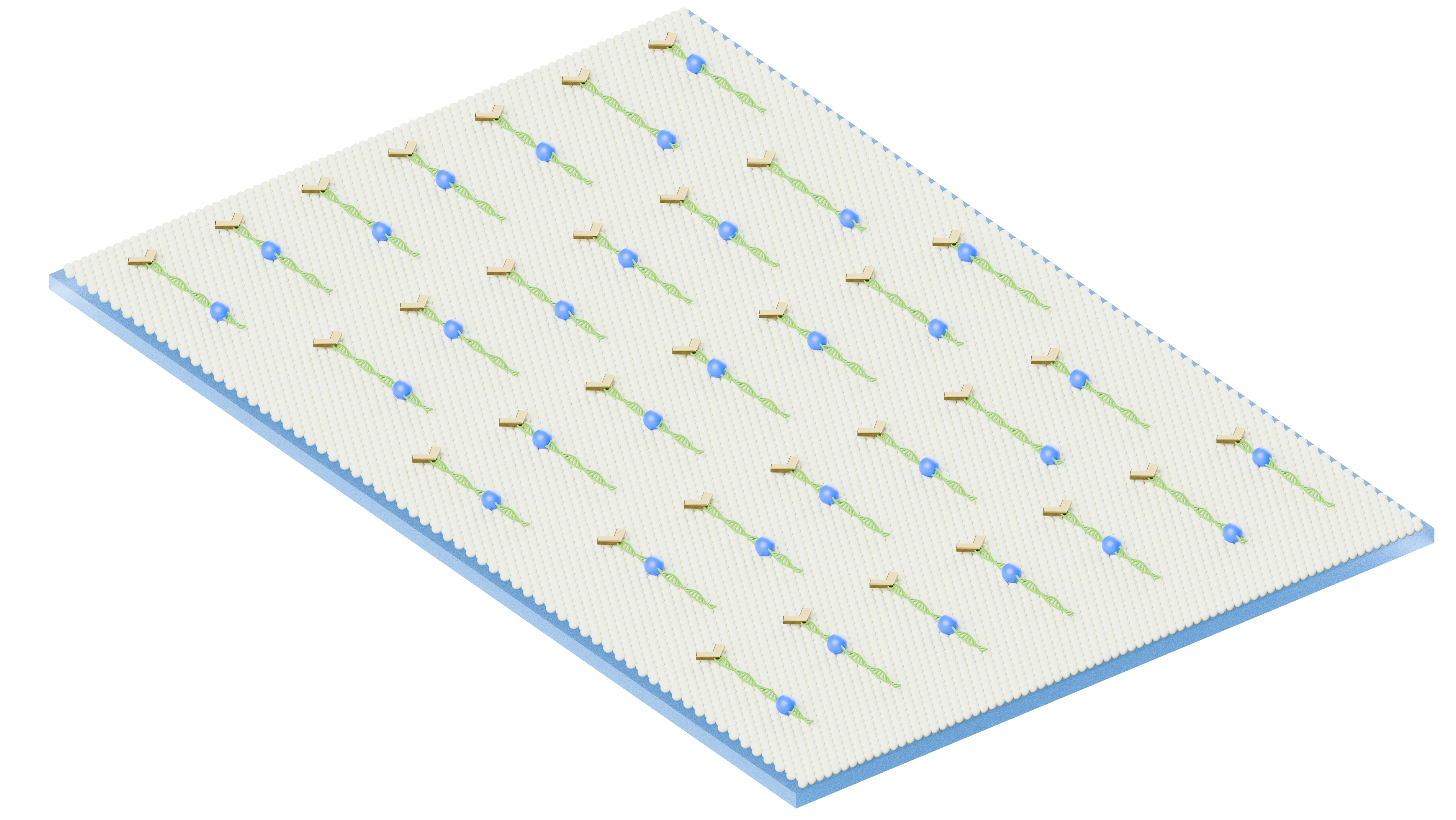
DNA Curtain — aligned DNA molecules on glass surface
100+
DNA molecules per field of view
<40 min
Setup time, start to data
6
Microfluidic channels per flow cell
0.5 µL
Channel volume — minimal reagent use
The Challenge

Single-molecule assays, now at scale

Single-molecule approaches are powerful, but traditionally suffer from low throughput. DNA Curtains solve this problem — directly, elegantly, and cost-effectively.

Low Throughput — Solved

Traditional single-molecule assays observe one molecule at a time. DNA Curtains align and image hundreds of DNA molecules simultaneously, delivering bulk-level statistics from a single experiment.

Direct Observation

Unlike indirect probing techniques, DNA Curtains provide real-time, direct visualization of DNA-binding protein dynamics. Data interpretation is intuitive and free from complex processing assumptions.

Accessible Technology

Designed to be compatible with any objective-type TIRF microscope. Straightforward setup, clear workflow, and cost-effective acquisition — opening single-molecule biophysics to a wider community.

The Product

The DNA Curtains Flow Cell

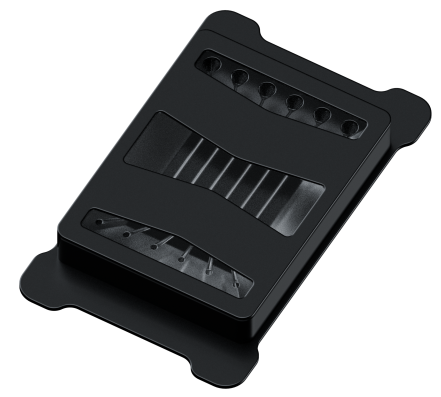
Manufactured by 1NA, the DNA Curtains Flow Cell is a precision-engineered microfluidic device featuring nanofabricated barriers produced by electron-beam lithography on a glass coverslip.

Its six independent channels are optimized to minimize sample consumption, with a dead volume of just 2 µL and typical experiments requiring only ~10 µL of sample at nanomolar concentrations.

DNA Curtains Flow Cell
Technology

How DNA Curtains work

Three steps from sample to high-throughput single-molecule data.

1

Lipid Bilayer Formation

All surfaces of the microfluidic channel are passivated with a supported lipid bilayer (SLB), tethering DNA while minimizing non-specific protein binding.

2

DNA Tethering

DNA is anchored to the SLB via biotin–streptavidin coupling. Applying gentle flow drives tethered DNA toward the nanofabricated barriers.

3

Curtain Formation & Imaging

Barriers capture and align hundreds of DNA molecules at their leading edges, forming a DNA Curtain ready for TIRF imaging and protein interaction studies.

Explore the Technology
Applications

Built for the questions that matter

DNA Curtains have been used in high-impact research across core areas of molecular biology.

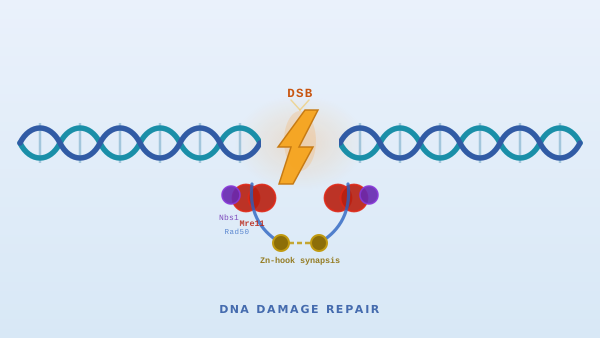
DNA Damage Repair

DNA Damage Repair

Visualize repair machinery in action — from MRN complex recruitment to resection and pathway choice.

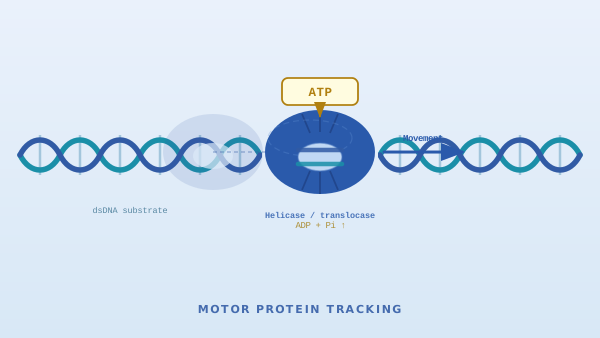
Motor Protein Tracking

Motor Protein Tracking

Track translocation, velocity, and processivity of helicases, translocases, and polymerases along individual DNA molecules.

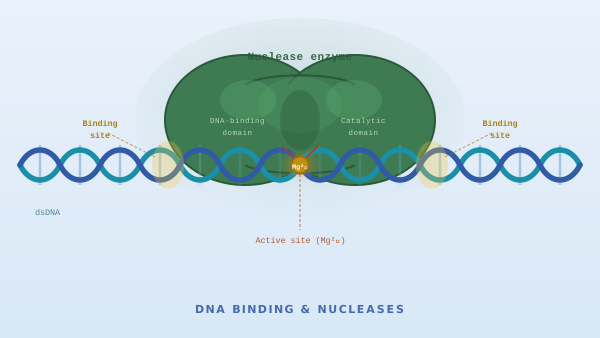
DNA Binding and Nucleases

DNA Binding & Nucleases

Quantify binding dynamics, search mechanisms, and cleavage activity — including CRISPR-Cas9 interrogation.

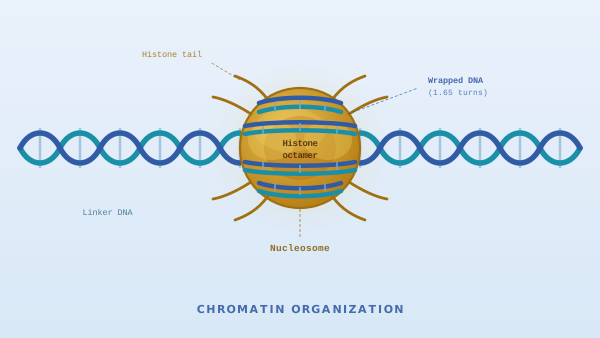
Chromatin Organization

Chromatin Organization

Study nucleosome assembly, loop extrusion by cohesin, and chromatin remodeling at the single-molecule level.

All Applications
Scientific Impact

Published in top-tier journals

DNA Curtains technology has enabled discoveries published in Nature, Science, Molecular Cell, PNAS, and more.

DNA Repair
Single-Molecule Imaging Reveals How Mre11-Rad50-Nbs1 Initiates DNA Break Repair
Myler L.R. et al.  Molecular Cell (2017)
Chromatin
Human cohesin compacts DNA by loop extrusion
Kim Y. et al.  Science (2019)
CRISPR
DNA interrogation by the CRISPR RNA-guided endonuclease Cas9
Sternberg S. et al.  Nature (2014)
View All Publications
Get Started

Ready to bring DNA Curtains to your lab?

Contact us for pricing, compatibility questions, or to discuss your specific research application.

Contact Us